Act III · Plan · Step 09 of 10
One question. The same answer, every single time.
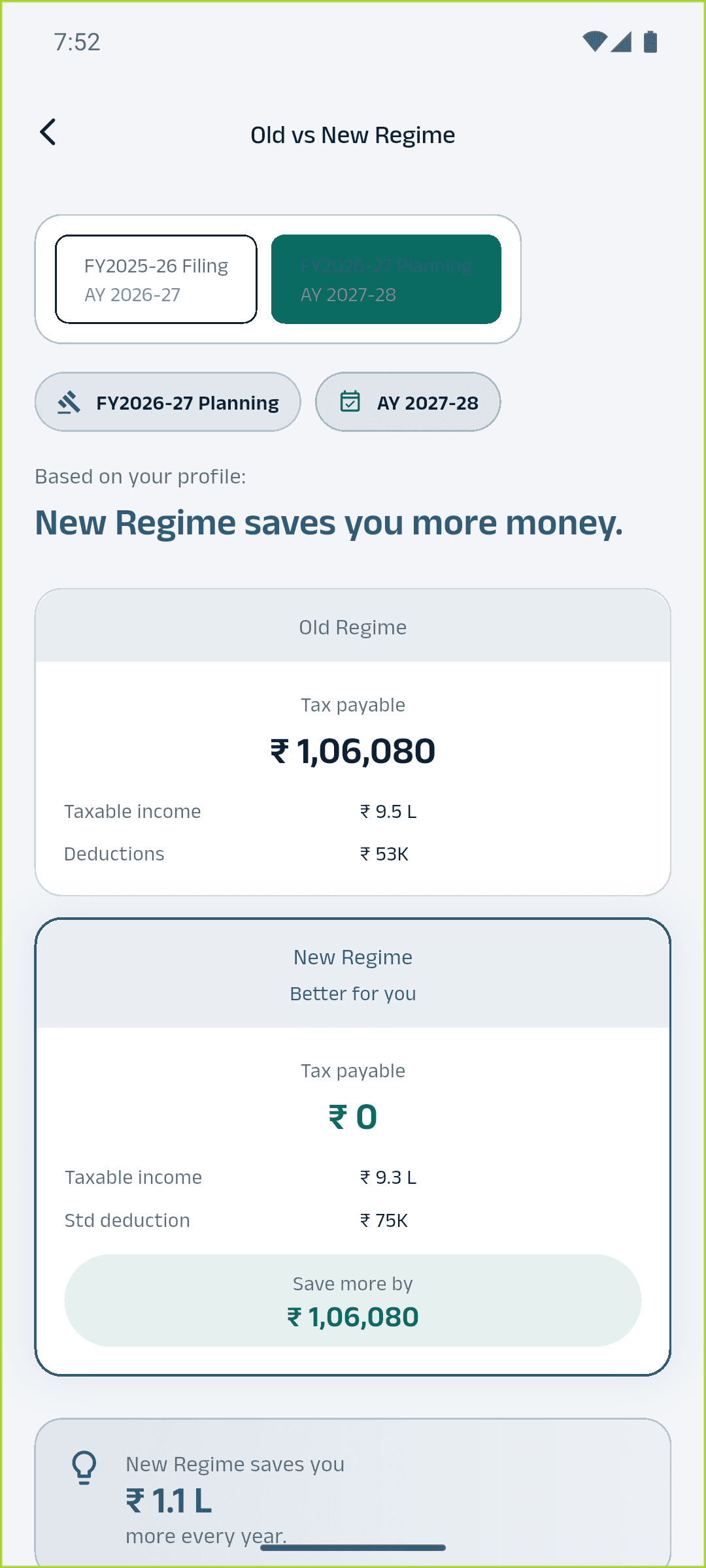
Old regime or new. Both computed in full on your confirmed figures, with the exact deduction it would take to flip the answer.
- Compares
- Both regimes, computed in full
- Shows
- The break-even deduction
- Reproducible
- Same inputs, same answer
The most consequential tax decision, made by copying a colleague.
Payroll asks in December, and a whole floor answers based on what the person next to them said.
That is not laziness - the honest answer means running your whole computation twice. And it is genuinely non-obvious: the new regime wins by default until a specific level of deductions, which moves with your income and your rent.
Tax Year 2026-27 · ₹15 lakh CTC
DeterministicDifference before deductions
₹1,59,120
Not which regime is better. Which is better for you.
Which one is better for you, at the deductions you actually have, and what it would take to flip it.
How the comparison is made.
The point is not the verdict. It is that you can check the working behind it.
- 01The engine
Both regimes are computed end to end.
Slabs, standard deduction, rebate, surcharge and cess, applied fully on both sides. Neither is approximated for speed.
- 02The engine
Your real deductions go into the old-regime side.
Every deduction you hold today - not the ones you might hold if you invested more.
- 03On your phone
The difference is shown as a rupee figure.
Not a percentage, not a badge. What the choice is worth to you this year, in rupees.
- 04The engine
The break-even is calculated.
How much more deduction it would take for the other regime to win. That figure is either reachable or clearly not.
- 05You
You open the working.
Every figure expands into its inputs and steps, with the rule version recorded beside the result.
- 06You
You tell payroll.
You get a defensible answer. The declaration to payroll stays yours to make.
What the comparison accounts for.
Both regimes carried into the Income-tax Act, 2025 unchanged. The engine is versioned so the working stays explainable later.
- Slabs and rates
- The full Tax Year 2026-27 structure per regime, applied to your taxable income - not a bracket lookup.
- Standard deduction
- Available under both regimes for salaried income, at this year's amounts.
- Rebate
- The thresholds differ sharply between regimes, and for many people this one term decides it.
- Surcharge and cess
- Applied at the right thresholds, including where the two regimes treat surcharge differently.
- Deductions that survive
- The employer NPS contribution still cuts tax under the new regime, and the comparison counts it.
- Break-even deduction
- The deduction level where both regimes produce the same tax. The most useful number here.
The same engine is running on the home page, right now.
The estimator on the home page is a port of this engine. Put your own salary into it - no account, no signup, no email.
What we promise.
Held on purpose. Not a gap waiting for a roadmap.
The choice and the declaration stay yours. ARTH tells payroll and the department nothing.
No product is ever suggested to move your break-even - not an investment, not a policy.
A computation on the figures you supplied, described as exactly that. Your CA remains your CA.
Both regime figures come from the rule engine. No model touches either one.
Settle the regime question once, with your own numbers.
Controlled Android beta · Tax Year 2026-27 · Income-tax Act, 2025