Act II · Money · Step 05 of 10
Nobody ever tells you what having a job costs.
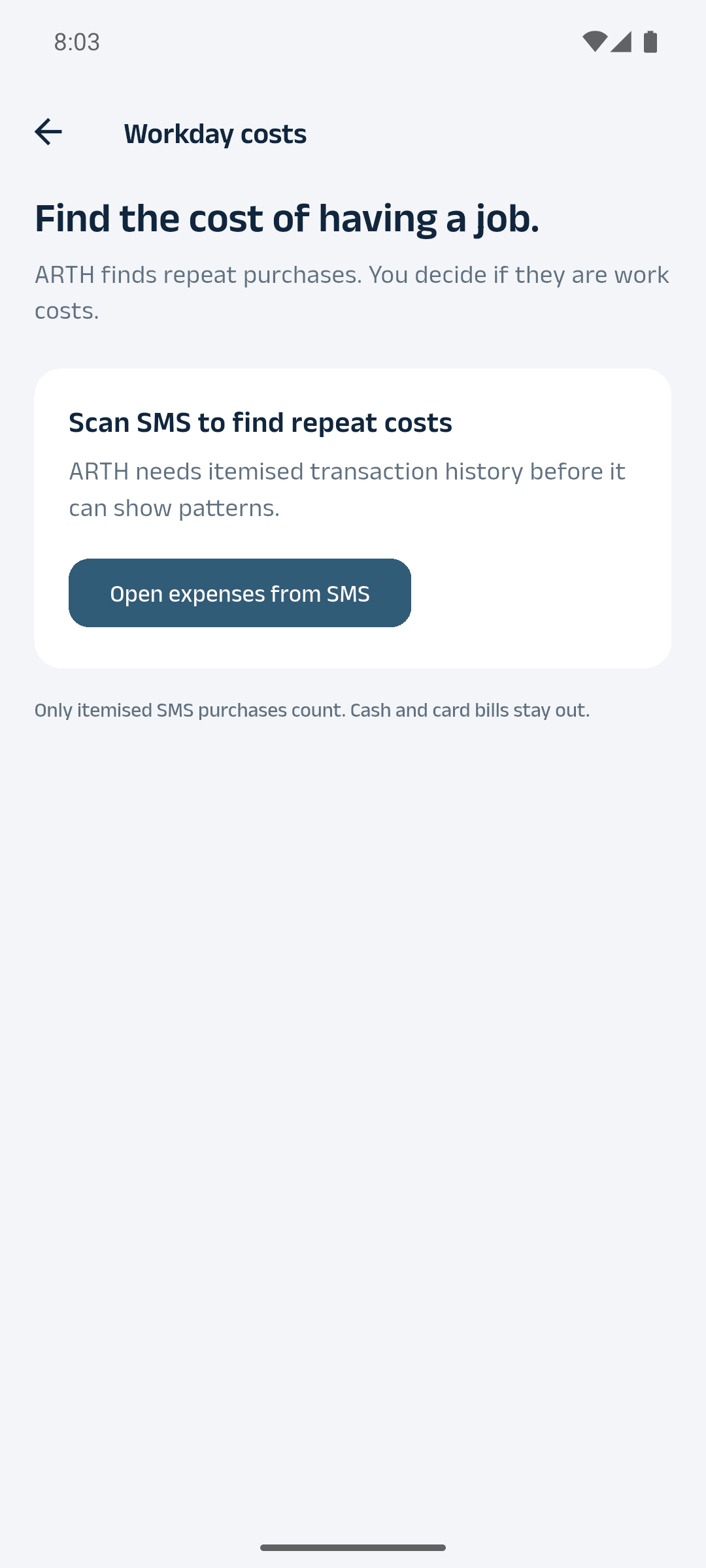
The commute, the desk lunch, the 4pm coffee, the laptop stand you bought yourself. ARTH finds the repeats. You say what they mean.
- Finds
- Repeat merchants, from your SMS
- Decides
- You. Intent is yours to give
- Shows
- The full maths, every time
Your salary is gross. Your job is not.
Two offers, same CTC. Forty minutes each way with a canteen is not the same pay as ninety minutes and a ₹300 lunch.
The cost of working hides in ordinary spending. It is never a line item - it is forty small transactions a month that read as life rather than overhead.
Repeat merchants found
from your own SMS
Median ₹240 × 52 weeks ÷ 12 months
₹1,040 / month
Only you know the Tuesday cab was for work.
So ARTH finds the pattern, you do the labelling, and your answer stands.
How a repeat merchant becomes a monthly cost.
One constraint shapes this whole screen: intent comes from you, never from the transaction.
- 01On your phone
Repeat patterns are surfaced.
From merchants the spend map already resolved, the ones on a weekday rhythm: same cab, same lunch spot, same top-up.
- 02You
You tag what each one is.
Commute, office meals, coffee, work tools, work social - or nothing. An untagged merchant counts zero, and none arrive pre-ticked.
- 03The engine
The maths is done in the open.
Median amount, times visits a week, times 52, over 12. The formula sits under the number with its inputs.
- 04You
You adjust the frequency.
Three days in, not five. Cab only when it rains. A median transaction cannot know your week; you can.
- 05On your phone
It sits beside your net pay.
Your monthly workday cost, right beside your confirmed net pay. Together they answer what the job is worth.
- 06You
It feeds the sandbox.
Price a move, a job or a vehicle and your tagged costs are already there. Nothing to re-enter.
What counts as a workday cost.
Five tags, plus an explicit none of these. Short on purpose.
- Commute
- Cabs, autos, metro, fuel, parking. The biggest line for most people, and the most sensitive to office days.
- Office meals
- Lunch bought near work - the gap between a canteen and a ₹300 neighbourhood.
- Coffee and snacks
- Trivial one at a time. The line that surprises people most over a year.
- Work tools
- Software, a monitor, a chair, a stand - bought so you could do the job the job did not fund.
- Work social
- Team dinners, farewells and birthdays. Optional in theory, in practice not.
- The arithmetic
- Median amount × visits per week × 52 ÷ 12. Every input editable, the formula on screen.
What we promise.
Held on purpose. Not a gap waiting for a roadmap.
Your tag is the only thing that makes a transaction a work cost. Untagged means uncounted.
However obvious the pattern looks, ARTH waits for you to name it.
Workday costs sit beside your salary, not subtracted from it - they are a cost of the job, not a payroll line.
This is a cost lens, not a deduction. Where your employer reimburses, the paycheck chapter handles the claim.
Find out what the job actually pays.
Controlled Android beta · Tax Year 2026-27 · Income-tax Act, 2025